
Many Ontarians are left scratching their heads at the recent COVID regulations issued by the Ford government in an effort to curb soaring counts of COVID cases in Ontario.
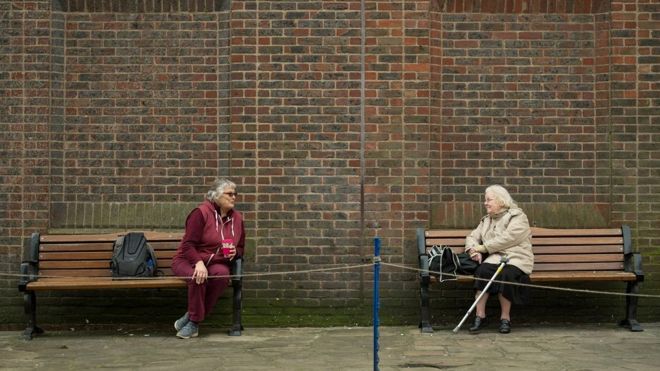
The new measures stress the importance of minimizing social contact as much as possible, with the Premier requesting that people maintain close contact only with those in their immediate households.
These measures might seem reasonable enough in the midst of global second wave, until you consider the measures the Ford government has not taken. Businesses, including gyms, restaurants, bars, and banquet halls all remain open (with some restrictions), not to mention Ontario schools, where thousands of students congregate everyday.
How do we make sense of this discrepancy? Why is it that individual Ontario residents are being asked to essentially perpetually quarantine themselves, while businesses and schools still have the green light to operate with some minor restrictions on capacity and mask wearing mandates?
On the face of it, these selective restrictions don’t seem to make a whole lot of sense; by what rationale do policy makers justify this dichotomy between aggressive restrictions in the private sphere and feeble guidelines in the public sphere?
When we try to parse through the logic of these policies for some guiding principle, we find that they are not in fact informed by a scientific or epidemiological rationale at all; rather, these policies serve a more poetic function, and by that, I mean they help to tell a story, a very popular story in the broader mythology of neoliberalism.
“Neoliberalism” has come to mean a host of things; here, I refer to neoliberalism as a coordinated political program to frame all social, political, and economic problems as being rooted in the actions and behaviors of isolated individuals.
Neoliberalism offers an especially appealing narrative for governments. Traditionally tasked with organizing and implementing collective social interventions to address collective problems (and funded collectively through taxes to do so), in the event that a particular governmental intervention fails, policy makers can point to a convenient new scapegoat: the individual.
Is your local public transit run down, overcrowded, and unreliable? Blame individual transit riders for skimping out on paying their fares. Does nearly half of the country have no money saved up whatsoever in the event of an emergency? That’s because millions of individuals, who otherwise don’t have anything to do with each other, aren’t making wise choices with their money.
Are hospitals overcrowded, without sufficient equipment, and overburdened right now? That’s because not enough people are wearing masks. You people. You aren’t social distancing enough. You aren’t taking this seriously enough. You are to blame.
Probably the most convenient aspect of the neoliberal story for governments is that it recruits the public to do its own dirty work. Once it is rhetorically established that those amorphous, nameless “Other People” are to blame for the pandemic, the gears of the psychological machine of collective scrutiny begin churning, like tossing a single ham into a den of voracious lions.
With individuals established as the primary culprits for all social problems, neoliberal storytelling has remarkable knack for turning its prized individuals against each other, initiating a negative feedback loop of reflexive scrutiny, contempt, and mistrust between members of the public who at once cannot trust others, and themselves cannot be trusted to “do their part.”
From a corporate-managerial perspective, this is exactly the kind of power you want to have over your subordinates. The careful surveillance, regulation, and discipline of staff in order to compel adherence to institutional policies requires extensive resources and exhaustive monitoring mechanisms; in other words, it’s expensive. But if you can manage to convince your subordinates to internalize institutional policies, especially if they are framed as being “for the greater good,” well sit back, relax, and watch them tighten their belts while meticulously counting the notches in the belt straps of their peers.
Like their metaphorical corporate counterparts, shifting the onus of containing the pandemic onto individual members of the public has immense benefits for the Ford administration. Of course, COVID cases are rising, alarmingly fast. Its clear that something’s got to give – as any accountant will tell you, if you need to balance your budget, you have to adjust one side or the other of the balance sheet – whether it’s individuals or businesses or both, someone’s got to take the hit.
Requiring individuals to absorb the majority of the burden of containment and isolation allows businesses, schools, and public transit systems to continue to operate only minorly impeded. And so the façade of “business as usual” is maintained, and Ford doesn’t have to deal with angry parents upset at the disruption of their kids’ education or losing the support of his big business backers.
All of this is not to say that social distancing measures and mask wearing mandates for members of the public are not necessary or even perfectly reasonable given the challenge we face. That isn’t the issue here. The insidious nature of the neoliberal story does not come from it’s apple-pie truisms about the importance of taking individual responsibility for our actions. Rather, the neoliberal story derives its insidious nature from the stories it does not tell, the details it leaves out.
We are asked to avoid meeting up with friends and colleagues from other households. We are not asked to consider the impact years of austerity and funding cuts have had on our public health system.
We are asked to remain vigilant, to keep a close eye on our neighbors and report them for potential social distancing and public gathering violations. We are not asked to consider the fact that 44 percent of outbreaks in Toronto have been traced back to bars and restaurants.
We are told that indoor social gatherings of more than 10 people are strictly forbidden. And yet, when city residents bring conditions of dangerous overcrowding on public transit vehicles to the attention of transit officials, we are told, “Sorry you feel that way but physical distancing is not practical at all times and this limitation does not apply to public transportation.”
So think twice next time before making plans to meet up with that friend you haven’t seen in months, before reuniting with that colleague who just returned from out of province (unless of course you are hanging out at a bar or on the bus, in which case, have at it, invite even more friends along!) After all, you don’t want to be personally responsible for causing more deaths, do you?
 the everyday